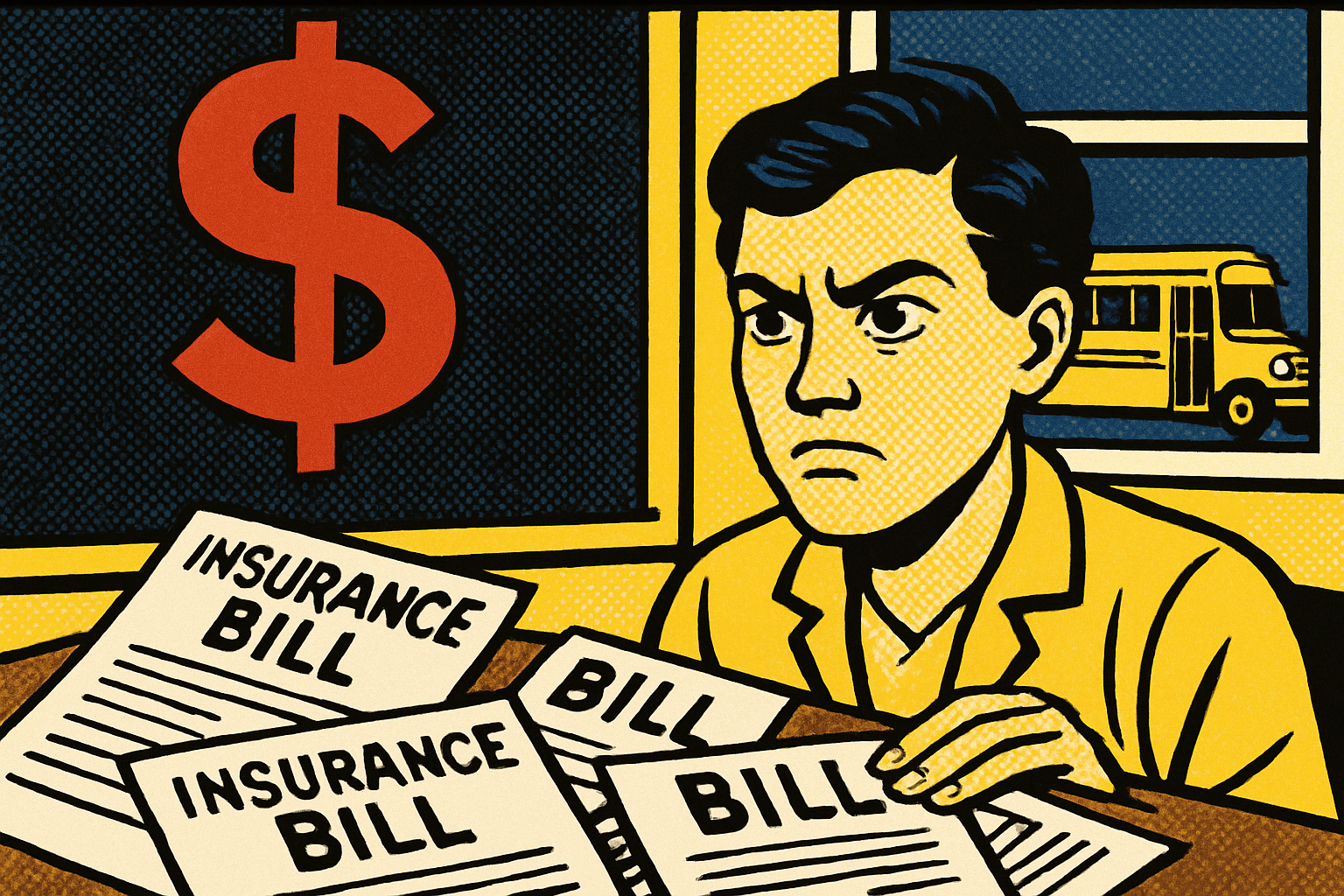
It's a familiar budget calculation: car insurance is $180 a month, and this month the water bill jumped. So you call your agent and drop the comprehensive coverage. You're still legal. You're still covered for liability. You're saving $90 a month — $1,080 a year. That math feels good.
Until your teenager backs into a lamppost and the repair estimate is $4,200.
Now you're $4,200 deeper in debt, your rates are higher because you're uninsured, and the $90 you saved per month for the last eight months just became one of the worst financial decisions of your life.
Here's the uncomfortable truth: skipping insurance to save money in your monthly budget is almost never actually cheaper. And the data behind why is worth understanding before you make your next budget call.
The Emergency Savings Reality Check
Let's start with a number that stops people cold when they see it: 59% of Americans cannot cover a $1,000 unexpected expense using their savings. That's not a rounding error or a niche finding — that's from Bankrate's 2025 Emergency Savings Report, one of the most comprehensive surveys of American household finances. And it's not getting better. The share of Americans who can cover a $1,000 emergency with savings has dropped from 44% in 2024 to just 41% in 2025.
Even among people who do have emergency savings, the numbers vary wildly:
- The median emergency fund balance across all working adults is around $500 (Empower, 2025).
- Among those who consider themselves "good savers," the average balance is $18,500 (Credible, 2025).
- The most commonly cited number: $5,000 median for people who actually have a dedicated emergency fund (U.S. News, 2026).
That $5,000 figure is important. Because here's what $5,000 covers in an emergency: one car accident with a $3,000 deductible. One serious illness with a $3,000 deductible and a month of medical bills. One house repair after a pipe bursts. One, singular event. And once it's gone, it's gone — and you're starting from zero for whatever comes next.
The Federal Reserve's 2024 Economic Well-Being report found that only 55% of American adults have enough saved to cover three months of expenses. That means nearly half of all American households would be in serious financial trouble if they lost their income for more than a couple of months.
What Skipping Coverage Actually Costs
Here's where the insurance math comes in. Let's say you're a 40-year-old with a 2019 Honda CR-V worth about $22,000, two kids, and a household income of $85,000. You're looking at your budget and thinking: we can save $85/month by dropping collision and comprehensive coverage. That adds up to over $1,000 a year.
Then, in October, your daughter pulls out of the driveway a little too fast and clips the neighbor's fence, then runs into a mailbox. The repair estimate on your CR-V: $6,400. Your liability covers the fence, but collision is your problem now.
One accident. No insurance. $6,400 bill.
Your $85/month savings for the last two years totaled $2,040. You just spent three times that on a single event — and you spent it at the worst possible time, when you weren't expecting it, with interest accruing.
This plays out constantly in American households. According to Kelley Blue Book, the average car repair in 2025 costs $838. The average home emergency repair runs $1,500–$3,000. A three-day hospital stay for something like appendicitis? $30,000–$50,000 before insurance, even with some coverage. And the number of families dealing with these bills is not small: over 115 million Americans under age 65 have struggled with medical bills, gone without care due to cost, or been uninsured at some point.
When the "Savings" Becomes a Catastrophe
The truly sobering numbers are in the bankruptcy data.
66.5% of all U.S. bankruptcy filings are linked to medical expenses. That's from the most recent data compiled by the World Population Review, and it's a figure that has stayed stubbornly high for years. In 2025 alone, there were 574,314 bankruptcy filings in the U.S. — an 11% increase from the prior year, and the highest in over a decade.
And here's the part that stops people: medical bankruptcies don't just happen to the uninsured. A 2025 study in Health Affairs found that bankruptcy filings rose 6% among trauma patients within 15 months of a serious injury — even among those who had insurance. The reason: even with good coverage, the combination of out-of-pocket costs, lost income during recovery, and out-of-network charges can overwhelm a family's financial foundation.
The Roosevelt Institute found that 23% of working-age adults with consistent insurance coverage were underinsured in 2024 — meaning their coverage would not protect them adequately from a major health event.
What does this mean for your budget? It means that the risk you're taking when you drop coverage isn't just "I might have a bad month." The risk is cascading: a single major event can destroy your emergency fund, rack up credit card debt, damage your credit, force you to dip into retirement accounts, and set your family back years on major financial goals.
The Smarter Budget Approach
Here's the truth that actually changes the math: insurance isn't a luxury — it's a structural part of your household budget, right alongside your mortgage, groceries, and utilities. The cost of insurance is not a place to find savings; it's the thing that protects every other savings goal you have.
A practical framework for budgeting around insurance:
Step 1: Know what you're actually paying for. Read your policy. Not the summary card — the actual policy. Know your deductible, your out-of-pocket cap (health insurance), and your coverage limits (auto and home). Many families discover for the first time that they have a $5,000 deductible and a $100,000 liability limit — and they're suddenly less confident in their coverage than they thought.
Step 2: Calculate the real cost of a gap. If you dropped collision coverage to save $90/month, what's the actual risk exposure? If your car is worth $22,000 and you can't cover that without going into debt, the $90/month savings isn't real savings — it's a bet that you won't have an accident. Most families win that bet for years, and then one day they don't.
Step 3: Find the right coverage tier, not the cheapest option. "Dropping coverage" and "having the wrong coverage" are different problems. If you genuinely can't afford comprehensive collision at $180/month, look at higher deductibles, different carriers, or bundled policies that get the same coverage for less. The answer to "I can't afford this" is rarely "skip it." It's usually "find a better version of it."
Step 4: Treat insurance like retirement savings — automate it. The reason most families don't have emergency funds is that they wait to save what they have left at the end of the month, and there's never anything left. Same with insurance gaps. If you haven't reviewed your coverage since you bought your house eight years ago, the world has changed. Construction costs, medical costs, car values — they've all moved. Your coverage probably hasn't.
The Bottom Line
Here's what we know: nearly 60% of American families would struggle with a $1,000 emergency. A single car accident or medical event can cost tens of thousands. And the savings from dropping insurance rarely cover even a fraction of what a single event can cost.
Protecting your family with the right insurance isn't optional financial planning — it's the foundation that every other financial goal is built on.