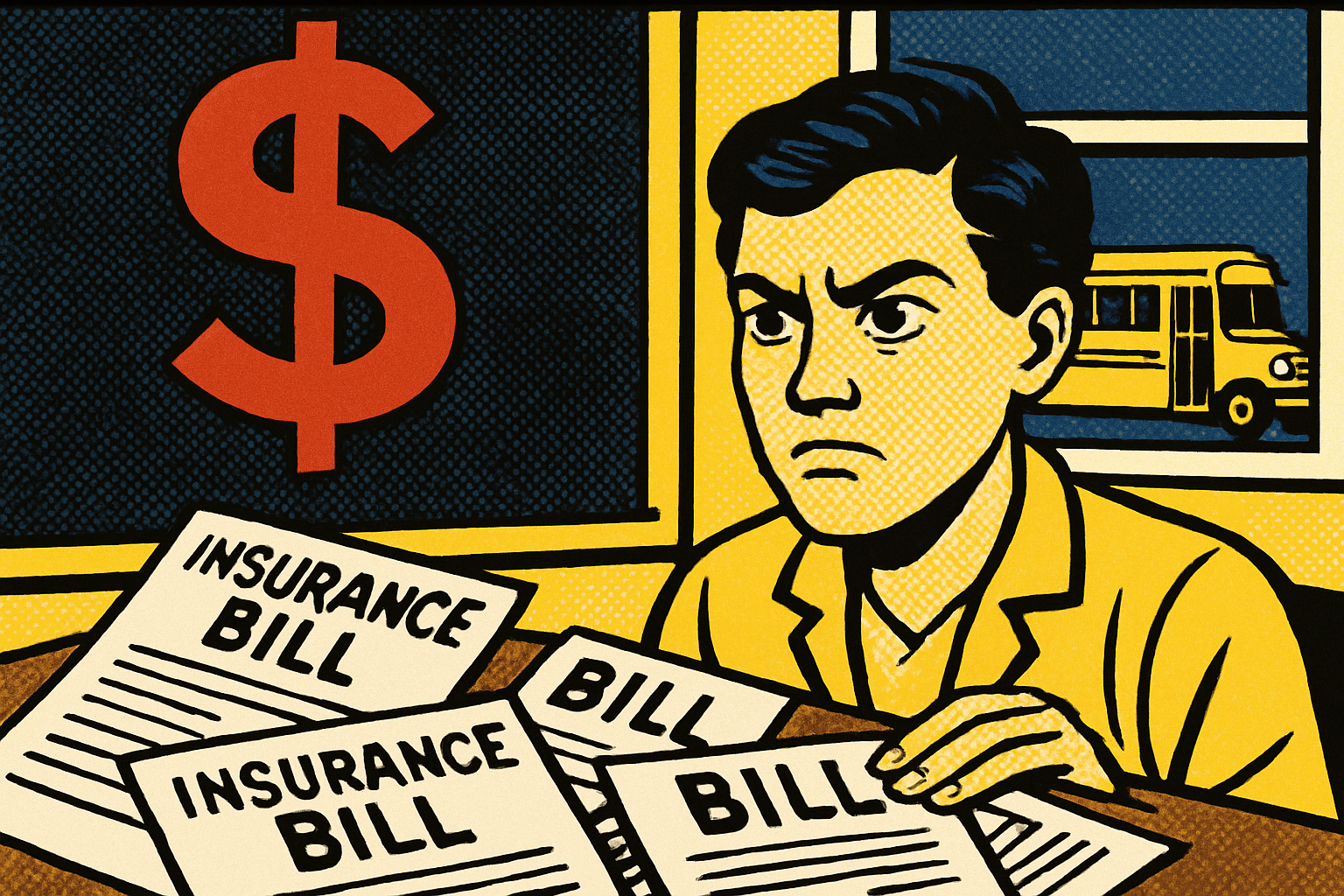
Your car makes a noise on a Monday. By Thursday, you are $1,400 into a repair you did not see coming — and your rent is due in six days.
Sound familiar? For 57% of Americans, an unexpected $1,000 expense would require borrowing money, selling something, or simply not paying something else. That is not a personal failure. That is a system working exactly as it was designed — a financial system that profits when you are always one breakdown away from the edge.
Here is what flips it: three months of expenses sitting in a dedicated account.
That is it. Not a stock portfolio. Not a side hustle. Just three months of your actual living costs, liquid and accessible. This single number — quietly recommended by every financial educator for decades — is the difference between a rough week and a financial spiral.
The Math Behind the Number
"Three months" is not arbitrary. It comes from real data on how long financial disruptions last.
The average job search takes 3 to 6 months. Medical emergencies carry out-of-pocket costs that average $1,500 to $3,500 depending on your insurance coverage. Car repairs that ground your vehicle average $500 to $1,800 per incident. HVAC failures: $1,200 to $5,000.
Notice something? These are not rare catastrophes. These are Tuesday. These are the normal wear of being alive in a modern economy.
Three months of expenses covers the duration of the disruption, not just the initial hit. If you lose your job tomorrow, three months buys you time to find a replacement without accepting a pay cut out of desperation. If you are hospitalized, it covers your bills while you recover — so you are not healing in a panic.
The math: Take your monthly expenses — rent/mortgage, utilities, groceries, insurance premiums, minimum debt payments, transportation — and multiply by three. That is your target. For most Americans, that is somewhere between $8,000 and $20,000.
What Happens Without One
The debt spiral. When you do not have cash reserves, emergencies become credit card charges. The average credit card APR is 22%. A $2,000 car repair on a credit card, paid off over 12 months, costs you $2,240. Paid off over 24 months? $2,530. You paid a 27% premium to fix your car. And while you are carrying that balance, your financial flexibility is compressed for the next year or two.
The under-insurance trap. This is the one nobody talks about. When money is tight, insurance feels like a luxury. People drop coverage, raise deductibles to uncomfortable levels, or skip riders that would actually protect them. They are betting that nothing bad happens — because they cannot afford the alternative. And when something bad does happen, the gap between what insurance pays and what they owe lands on a credit card. The spiral deepens.
The income-compression effect. Without an emergency fund, every job decision is made from desperation rather than choice. You cannot negotiate. You cannot leave a bad situation. You cannot say no to a bad offer. People with financial cushion earn more over time — not because they are smarter, but because they can afford to be selective.
Where Insurance Fits In
Here is the relationship between emergency funds and insurance that nobody explains clearly:
Insurance covers the catastrophic. Your emergency fund covers the deductible.
Your health insurance might have a $3,000 deductible. Your car insurance might have a $1,000 deductible. Your homeowner's policy might not cover the plumber if the pipe just aged out. Insurance is the firewall against the $80,000 cancer treatment or the $350,000 house fire. Your emergency fund is the buffer that lets insurance actually function.
Without savings, a $3,000 health deductible is not protection — it is a mechanism to push you into debt while you are already sick.
This is also why your emergency fund and your insurance premiums should be calibrated together. Higher deductible plans lower your monthly premiums — which frees up cash to build your emergency fund faster. Once your fund is solid, you are genuinely self-insuring the deductible layer. It is a system. Each part makes the other more effective.
Building It: The Non-Intimidating Version
The number can feel big. It is not meant to be built in a month.
Step 1: Name it. Open a separate savings account — high-yield, if possible (current rates are 4.5–5.0% APY at most online banks). Name it "Emergency Fund." Not "Savings." Not "Rainy Day." The specificity matters psychologically.
Step 2: Start with $500. That is the most important milestone, not the full three months. $500 covers most car repairs, most ER copays, most immediate crises. Getting to $500 first breaks the "this is impossible" narrative.
Step 3: Automate $50–$200/month. Whatever you can manage. Set it to transfer automatically the day after your paycheck hits. It is not a sacrifice — it is paying yourself first. Treat it like a bill.
Step 4: Do not touch it. Define what counts as an emergency before you need to decide under stress. Car breakdown: yes. Sale ends tonight: no. Medical bill: yes. Flight to Vegas: no.
Step 5: Rebuild after use. If you use it, that is the system working. Resume contributions as soon as the emergency is resolved.
Most people hit their three-month target within 18–24 months of focused saving. The psychological shift that happens along the way — the reduction in baseline anxiety, the improved sleep, the way you start making decisions from a place of confidence rather than fear — starts within the first few weeks.
The Insurance Layer You Might Be Missing
Emergency funds and insurance are designed to work together. Most people have one without the other — or neither — and wonder why financial stability feels impossible.
If your current coverage has gaps — high deductibles you could not actually meet, missing life insurance, no disability coverage that would replace income if you could not work — those gaps become emergency fund emergencies.
The right insurance setup means your emergency fund stays intact for the unexpected, not for predictable gaps in coverage.
If you are not sure whether your current coverage matches what you actually need, that is exactly what a licensed insurance agent can help you figure out. Not to upsell you. To map your coverage against your actual risk, find the redundancies you are paying for, and identify the gaps that could wipe out any savings you have built.
Ready to make sure your coverage is as strong as the emergency fund you are building? Get matched with a licensed insurance agent — no pressure, just clarity on what you actually need.